Do Lenders Offer Zero Down for Equipment?
Do lenders offer zero down for equipment? Learn when $0 down may be possible, what lenders review, and how commercial deals are structured.


A 10-year-old excavator with documented maintenance, productive hours, and a strong resale market may be a better finance candidate than a newer unit with excessive wear or an unclear ownership history. That is the practical answer to why equipment age matters financing decisions. Lenders do not evaluate the model year in isolation. They evaluate whether the asset will remain useful, marketable, and capable of producing revenue throughout the proposed term.
For a fleet operator or equipment-dependent business, that evaluation affects more than an approval. It can influence term length, down payment expectations, documentation requests, eligible funding sources, and how quickly a transaction can move from a vendor quote to equipment in service. Age is one underwriting factor among several, but it often becomes more significant as an asset approaches the outer edge of its useful life.
Commercial equipment financing is generally secured by the equipment being purchased. If a borrower cannot perform as agreed, the funding source needs confidence that the asset has identifiable value and can be resold in a commercially reasonable market. Newer equipment usually offers a clearer valuation, more remaining useful life, and a larger potential buyer base. Those characteristics can make underwriting more straightforward.
Older equipment can still be financeable, particularly when it is a recognizable make and model with established demand. But the transaction may receive more scrutiny. A lender may want to know the exact year, serial number, mileage or engine hours, condition, maintenance history, and whether the unit has a clean title or is subject to any existing lien.
The central issue is not whether older equipment is inherently bad. It is whether the requested financing structure makes sense for that particular asset. Financing a 15-year-old dump truck over a long term, for example, may create a mismatch between the remaining economic life of the truck and the repayment period. A shorter structure, a larger down payment, or a different funding source may be more appropriate depending on the business profile and equipment condition.
A calendar year does not tell the full story. A late-model truck with very high mileage, accident history, or deferred maintenance may present a greater risk than an older truck that has been carefully maintained and operated in a predictable route. The same is true for yellow iron. An excavator’s hours, service records, undercarriage condition, attachments, and operating environment can be more meaningful than its age alone.
Specialized assets add another layer. A wrecker, rollback, ambulance, bus, or non-emergency medical transport vehicle may carry valuable upfit components, but the funding source will also consider how broadly the asset can be resold. Equipment built for a narrow application can have a smaller secondary market than a conventional tractor, standard trailer, forklift, or common construction machine.
Funding sources commonly consider expected collateral value over time. Equipment with a stable used market is often easier to place than equipment with uncertain resale demand, unusual specifications, extensive damage, or obsolete technology.
That does not mean a business should only buy the newest unit available. An older machine can be a sound purchase when its price, expected uptime, maintenance needs, and revenue potential support the transaction. The key is to avoid treating the purchase price as the only number that matters. A lower acquisition cost can be offset by repairs, downtime, limited parts availability, or a financing structure that requires more cash upfront.
Established businesses often purchase used equipment for disciplined reasons. A contractor may need a proven excavator for a defined project pipeline. A towing company may add a well-maintained rollback to cover a service territory. A carrier may replace a failing tractor with a used unit that can enter service quickly without committing all available cash to a new truck.
In these situations, the quality of the file matters. Clear photos, complete specifications, a bill of sale or vendor invoice, maintenance documentation when available, and an accurate description of intended commercial use all help. A purchase from an established dealer may be easier to document than a private-party transaction, although private-party purchases can be workable when title, ownership, condition, and payoff details are properly verified.
Businesses should expect more questions as equipment gets older. That is not necessarily a negative signal. It is often the normal work required to match an asset with a lender program that fits its age, condition, and marketability.
A strong operating business can make a meaningful difference in an older-equipment transaction. Lenders typically look at the complete picture: time in business, commercial credit history, cash flow, existing debt obligations, fleet or equipment ownership, and the business’s experience using the asset being acquired.
Consider two companies seeking to finance the same 2012 vocational truck. One has several years of documented operations, a stable customer base, solid payment history, and comparable trucks already in service. The other has limited operating history and no demonstrated experience with that type of equipment. The truck is the same, but the underwriting discussion is not.
For an established company, a well-supported older-equipment request may be viable even if a newer asset would have been simpler to finance. For a business with a thinner file, an older asset can compound the challenge because both the collateral and the operating profile require closer review.
Cash down can also affect the structure. A larger down payment may reduce the amount being financed relative to the equipment’s value and show that the buyer has a meaningful stake in the purchase. It is one potential tool, not a universal requirement. Actual down payment expectations depend on the borrower, asset, seller, credit profile, requested term, and funding source.
The best financing structure is not always the one with the lowest monthly payment. Extending the term can preserve monthly cash flow, but it may not be practical for an older asset with substantial hours, mileage, or an uncertain remaining service life.
Start with the equipment’s job. Will the asset run daily and generate contracted revenue? Is it replacing a unit that is creating repair bills and missed work? Is it an additional truck or machine needed for a confirmed expansion? Then compare the expected monthly payment with realistic operating costs, including fuel, insurance, maintenance, operators, and any needed repairs.
A used box truck that supports local deliveries may have a different replacement cycle than a heavy-haul tractor. A forklift used inside one facility may accumulate wear differently than a skid steer operating on demolition sites. The business case should reflect the actual duty cycle, not just the seller’s asking price.
Replacement decisions are often made after a truck breaks down or a machine becomes too costly to maintain. That urgency is understandable, but waiting until the asset is out of service can limit options. A business that tracks mileage, repair frequency, downtime, and replacement timing can begin evaluating financing before a failure becomes an operational problem.
When a purchase is approaching, assemble the basic information early: the vendor quote, year, make, model, serial number or VIN, mileage or hours, equipment photos, seller details, and the intended business use. Be prepared to provide recent business financial information or bank statements if the transaction and lender requirements call for it. If there is a trade-in or payoff, identify that upfront as well.
A specialized equipment finance broker such as Commercial Fleet Financing can help qualified established businesses present the transaction to appropriate funding sources, coordinate with vendors, and address documentation issues before they delay closing. Available terms and timing will always depend on the asset, borrower profile, documentation, and lender requirements.
The practical move is to treat equipment age as part of replacement planning, not as a surprise after a purchase agreement is signed. The right question is not simply whether an older asset can be financed. It is whether that asset, at that price and with that structure, will keep earning more than it costs to own.
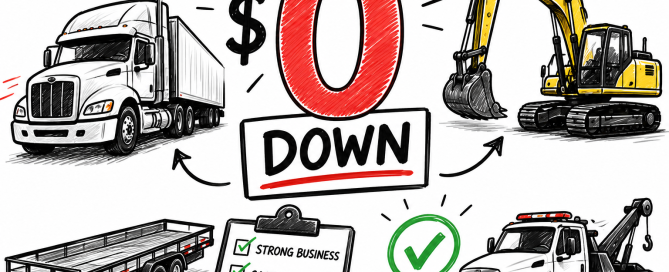
Do lenders offer zero down for equipment? Learn when $0 down may be possible, what lenders review, and how commercial deals are structured.
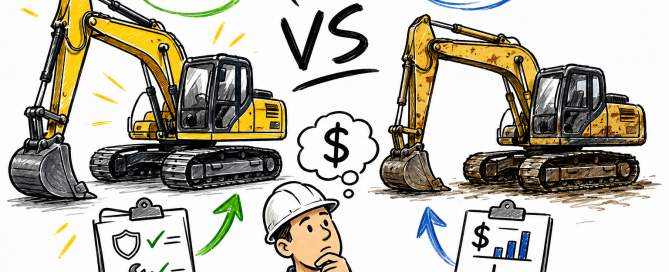
Compare new versus used excavator financing, including approval factors, down payment, terms, uptime risk, and total cost for buyers.
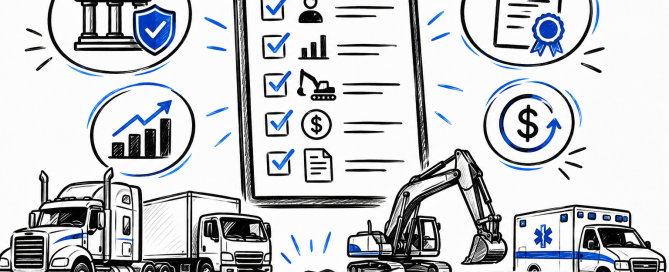
Commercial equipment financing requirements guide for U.S. businesses. Learn credit, cash flow, documents, down payment, and equipment factors.
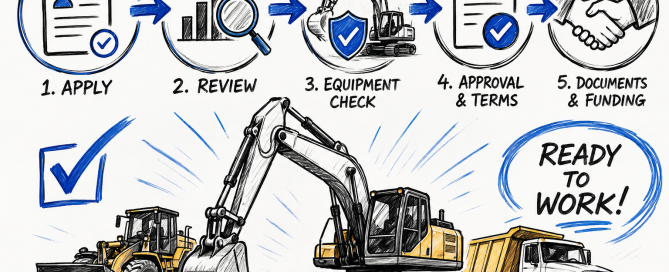
Heavy equipment approval process explained for contractors and fleets. Learn what lenders review, what slows approvals, and how to prepare.
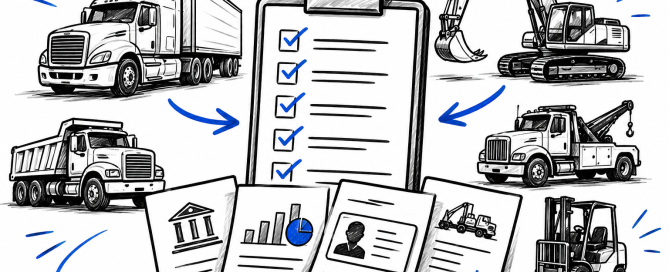
Learn what documents are needed for equipment financing, why lenders ask for them, and how to prepare a cleaner, faster commercial approval file.