Look Ahead To 2020 In Transportation: Are Haul Rates On The Rise?
Look Ahead To 2020 In Transportation: Are Haul Rates [...]

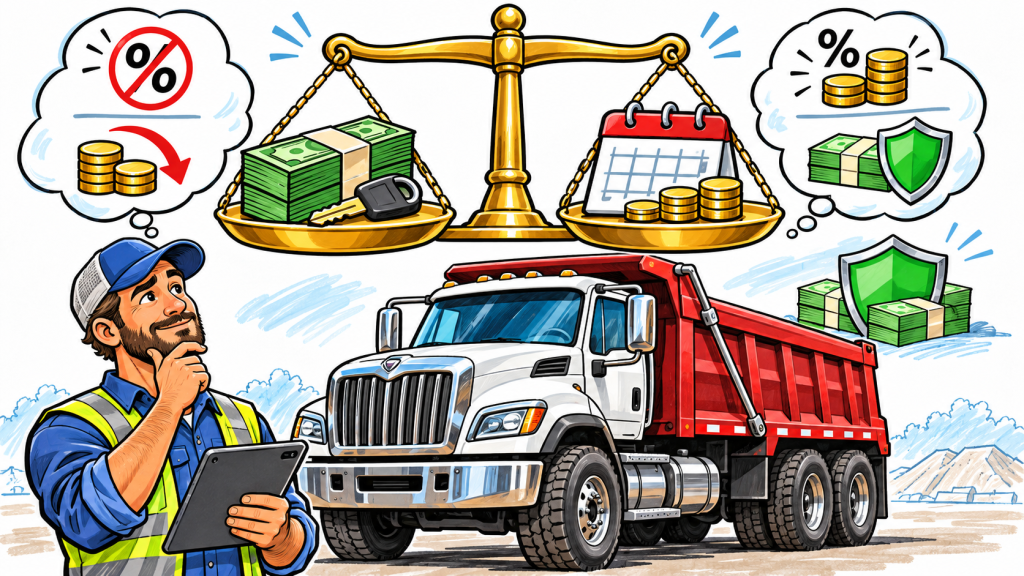
An available cash balance does not automatically make a cash purchase the better business decision. When a tractor needs replacement before repair downtime spreads, a towing company adds a wrecker, or a contractor needs an excavator for awarded work, the real question is whether the asset will produce enough value to justify using cash. Purchase financing versus cash purchase is a working-capital decision first and a payment decision second.
For established businesses, both paths can make sense. The right choice depends on the equipment’s revenue role, the age and condition of the asset, the company’s liquidity needs, and the cost of delaying a purchase. A lower total dollar cost is useful, but it is not the only measure that matters when equipment availability affects revenue, scheduling, and customer commitments.
A cash purchase eliminates interest expense and monthly debt service. It can simplify the transaction, particularly for a lower-cost used forklift, trailer, or service vehicle where the purchase will not materially reduce operating reserves. Sellers may also prefer a straightforward cash transaction, although a qualified financing transaction can be just as workable when documentation and closing steps are coordinated well.
The tradeoff is the cash that leaves the business. Money used to buy a $250,000 dump truck or a group of trailers cannot also cover payroll, fuel, insurance premiums, parts inventory, seasonal slowdowns, or an unexpected engine failure elsewhere in the fleet. A company with a healthy bank balance can still become cash-constrained after paying for a major asset outright.
Purchase financing preserves more of that liquidity by spreading the equipment cost over time. The business takes on a fixed payment, and the equipment should be evaluated against the revenue, cost savings, or capacity it is expected to create. This approach is often appropriate when the asset is essential to a contract, route expansion, replacement cycle, or higher-margin service line.
The decision is not simply “can we afford to pay cash?” A more useful question is: “What does this equipment allow us to do with the cash we retain?” If keeping capital available prevents operational disruption or supports profitable growth, financing may carry a practical value beyond its stated interest cost.
Financing generally costs more in nominal dollars than paying cash because the borrower pays interest and may have closing, documentation, or other transaction costs. The payment structure, term length, down payment, asset age, borrower strength, and lender program all affect that cost. A longer term may lower the monthly payment but can increase total interest paid over the life of the transaction.
That does not make the lowest payment the best structure. A five-year term on a late-model semi-truck may align well with expected service life and cash flow. The same term on an older, high-mileage truck could create a mismatch if maintenance exposure rises before the obligation is substantially paid down. Likewise, a construction company financing yellow iron should consider expected utilization, job backlog, transport costs, and the machine’s remaining useful life.
Cash purchasers should also account for the opportunity cost of capital. If cash retained in the business can support a project, reduce costly downtime, capture vendor discounts on materials, or keep a reserve intact, the economic comparison changes. That is a management judgment based on actual business conditions, not a universal financing rule.
Tax treatment may also affect the analysis, but it should not drive the equipment decision by itself. Depreciation, expensing elections, and interest deductibility can vary based on the business and current tax rules. A CPA or tax advisor can evaluate the implications for the company’s specific situation before a purchase is finalized.
A cash purchase is often reasonable when the business has excess liquidity after reserving for normal operating needs and foreseeable capital expenses. It can be especially practical for an asset with a modest purchase price, a short expected ownership period, or limited financing value because of its age, condition, or specialized nature.
For example, an established landscaping company might pay cash for a used skid steer attachment or a small utility trailer while preserving financing capacity for higher-dollar equipment. A transportation company may also choose cash for a well-priced late-model trailer if it has ample reserves and already carries payments on revenue-critical power units.
Cash can also help when a seller needs a rapid, uncomplicated close and the buyer has completed its due diligence. Equipment condition still matters. A quick cash transaction does not protect a buyer from undisclosed wear, missing service records, title issues, or a poor equipment fit. For used trucks and vocational equipment, inspection history, mileage, hours, maintenance records, and intended duty cycle remain central to the decision.
Financing becomes more compelling when the equipment is expensive, directly revenue-producing, and needed without draining capital needed elsewhere. An ambulance provider replacing aging units, a recovery company adding a rollback, or a logistics operator acquiring several tractors may have a sound reason to preserve reserves while putting the assets into service.
It can also help a business avoid concentrating too much capital in one depreciating asset. Commercial equipment is valuable because it works, not because it sits on a balance sheet. If financing allows a company to acquire the right asset now, maintain adequate operating liquidity, and service the payment from dependable utilization, it may support a more resilient operation.
A down payment can change the equation. Qualified borrowers may have access to structures with varying down payment requirements, but those options depend on credit profile, time in business, financial strength, fleet history, the asset, seller type, and lender requirements. Putting more down can reduce the payment and total financing cost. Putting less down can preserve capital. Neither choice is automatically better without reviewing the company’s broader cash needs.
The useful life of the asset should influence the financing structure. New equipment with a long service horizon often supports a longer amortization period than older equipment with high hours or mileage. A late-model box truck used on predictable local routes may be viewed differently from an older sleeper tractor intended for heavy over-the-road use.
The same principle applies to equipment condition and vendor source. New equipment purchased from an established dealer generally presents a different underwriting profile than a privately sold unit with incomplete maintenance documentation. Lenders may look closely at asset age, mileage or hours, inspection information, title status, and whether the equipment is appropriate for the borrower’s operation.
A company should avoid using an artificially low payment to justify equipment it cannot support operationally. The right asset must fit the work. A larger truck, more specialized body, or newer machine may create value through uptime and capacity, but only if utilization and margins support it.
Established businesses can improve the financing process by preparing the transaction details before committing to a seller. Common items include a formal equipment quote or purchase order, business information, ownership details, recent financial information when required, and equipment specifications. For used assets, the serial number or VIN, mileage or hours, photos, maintenance records, and seller information can be important.
The strength of the transaction is broader than a credit score. Underwriters may consider time in business, revenue stability, existing debt obligations, fleet size, payment history, collateral quality, industry experience, and how the equipment will be used. A company replacing a worn-out unit with a comparable revenue-producing asset may present a different profile than one moving into an unfamiliar equipment category or expanding quickly.
Timing matters as well. Financing decisions and funding speed can vary based on the borrower, equipment, documentation, lender requirements, title work, insurance, and overall deal structure. Coordinating early with the vendor helps avoid a situation where a unit is ready for delivery but documentation is incomplete.
The best comparison is often not financing cost versus zero financing cost. It is the cost of financing versus the operational cost of tying up cash, delaying a replacement, or running an unreliable asset too long. A truck that misses dispatches, a wrecker that cannot take a call, or an excavator that is down on a job can create expenses far beyond a monthly payment.
Before choosing, model a conservative monthly picture: expected payment, insurance change, fuel and maintenance impact, expected utilization, and the cash reserve left after closing. Then test the decision against a slower month or an unplanned repair elsewhere in the fleet. If the purchase still leaves the business able to operate confidently, the structure may fit.
Commercial Fleet Financing, Inc. works as a specialized equipment finance broker and financing partner, helping qualified established businesses evaluate equipment transactions, lender requirements, and structures across multiple funding sources. A productive conversation starts with the equipment, seller, intended use, business history, and the cash-flow objective behind the purchase. The goal is not simply to buy an asset. It is to put the right asset to work without creating an avoidable strain on the business.

Look Ahead To 2020 In Transportation: Are Haul Rates [...]

It’s true, 2019 brought a lot of blows to [...]

This year brought more smiles and cries to the [...]

While CFF holds a world-class reputation for our commercial [...]

The bill that California Senators just approved called ‘AB5’ [...]