Advantages of Financing a Dump Trailer for Your Business
Advantages of Financing a Dump Trailer for Your Business [...]

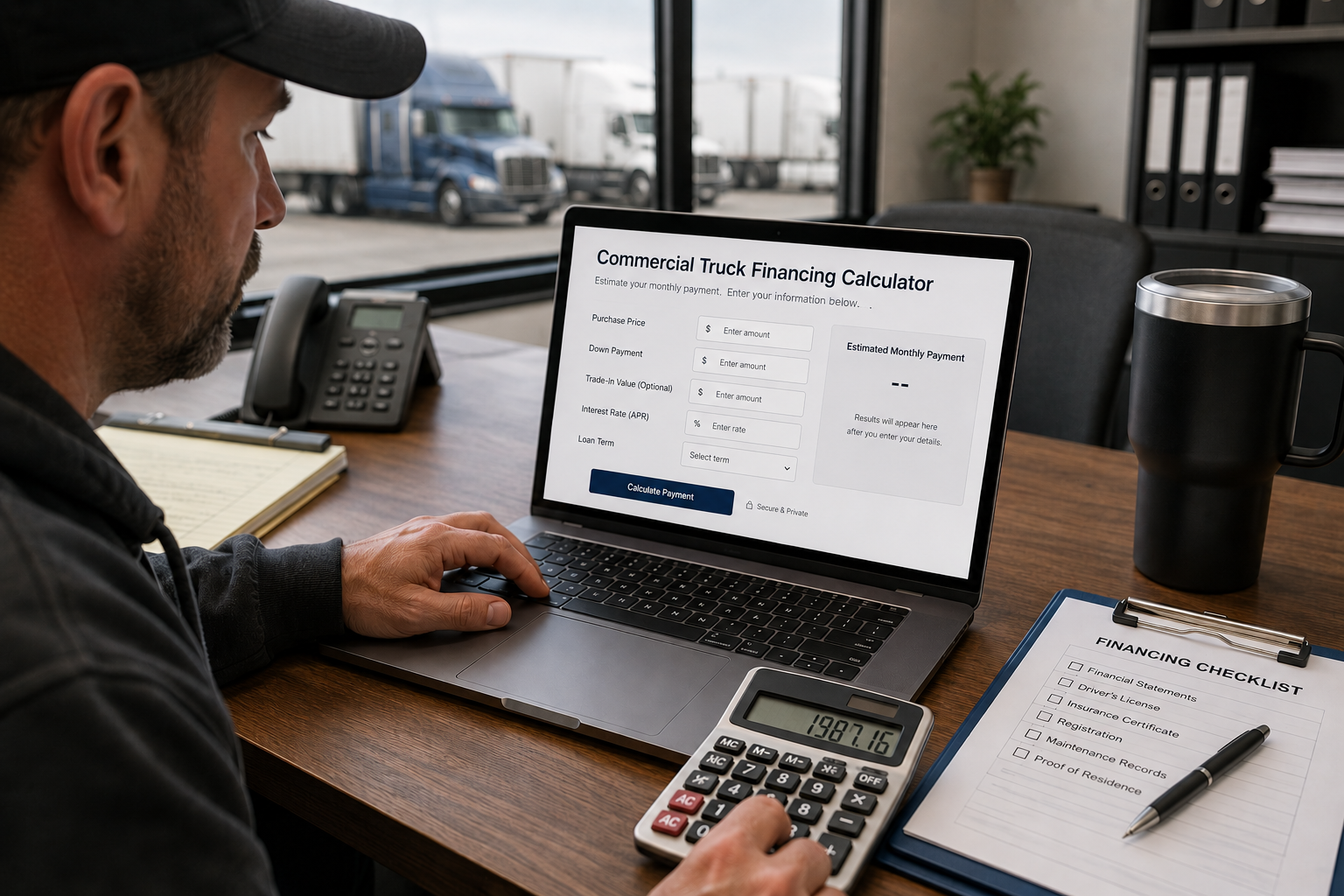
A truck payment that looks manageable on a listing page can turn into a very different number once term length, down payment, taxes, and equipment age enter the picture. That is why a commercial truck financing calculator is useful early in the buying process. It gives business owners, owner-operators, and fleet buyers a faster way to test monthly payment scenarios before they commit time to a specific unit or financing structure.
For commercial buyers, the point is not just getting a payment estimate. The real value is seeing how that estimate affects working capital, maintenance reserves, insurance costs, payroll, and the timing of your next equipment purchase. A truck has to do more than fit the budget on paper. It has to support revenue and keep the operation moving.
At its core, a calculator estimates a monthly payment based on the amount financed, repayment term, and an assumed financing cost. Some calculators also factor in a down payment, trade equity, taxes, and fees. That sounds simple, but even a basic estimate can help you answer better buying questions.
If you are comparing a newer sleeper tractor against an older day cab, or deciding whether to add one box truck now versus two later, payment visibility matters. It helps you see whether the equipment fits your current cash flow and whether a shorter or longer term makes more sense for the way the truck will be used.
A calculator is also useful because commercial equipment transactions are rarely one-size-fits-all. Financing for a startup owner-operator, an established fleet replacing aging units, or a contractor adding a dump truck may be structured differently depending on time in business, credit profile, collateral, equipment type, and the overall deal.
A commercial truck financing calculator is only as useful as the numbers you put into it. The biggest variable is usually the total amount financed. That includes the truck price, but it may also include taxes, title costs, add-ons, and other deal-related items depending on how the transaction is structured.
The next major factor is the down payment. More money down usually lowers the financed amount and monthly payment, but it also reduces available cash. That trade-off matters. Many businesses would rather preserve liquidity for repairs, fuel, hiring, or seasonal swings than put every available dollar into the truck upfront.
Term length changes the picture quickly. A longer term can lower the monthly payment, which may help cash flow. But it can also mean paying more over time. A shorter term may save on overall financing cost, yet the higher monthly obligation can put pressure on operations if receivables are slow or utilization drops.
Equipment type and age also matter more than many buyers expect. A new semi-truck, a used rollback, and a high-mileage vocational truck may not be viewed the same way from a financing standpoint. Lender appetite, collateral value, and expected service life all influence deal structure.
After you compare payment scenarios, use a profitability tool like CFF’s Budget Builder to pressure-test the bigger question: whether the equipment can support the payment and still leave room for operating costs. The best way to use a calculator is to build a range, not chase one perfect number. Start with the truck price and enter a realistic down payment. Then test multiple term lengths. Look at the difference between a conservative scenario and a more aggressive one.
For example, if one payment only works when revenue assumptions are strong, and another works even during slower months, the second number may be the better operational choice. Commercial financing decisions are not made in a vacuum. They should be measured against what the truck is expected to produce and what the business needs to keep in reserve.
It also helps to think beyond the base payment. Add insurance, registration, permits, maintenance, fuel, driver cost if applicable, and any upfit or compliance expense. A calculator may estimate the financing piece, but your actual truck cost is broader than the note.
Say a business is looking at a used box truck to expand local delivery routes. The buyer tests three options in a calculator using different down payments and term lengths. One option produces the lowest monthly payment, but only because the term is stretched out significantly. Another has a higher payment, yet it aligns better with the truck’s expected service window and leaves the business in a stronger equity position sooner.
Neither option is automatically right. It depends on route stability, current cash reserves, and how quickly the truck is expected to generate dependable revenue. That is where a calculator becomes a planning tool instead of just a payment tool.
A commercial truck financing calculator gives an estimate. It does not tell you what structure a financing source may actually approve, what documentation will be required, or how equipment age and borrower profile may affect available options.
It also does not reflect every deal-specific detail. A strong borrower with established business financials, relevant industry experience, and clean collateral may have a different set of options than a newer business or a transaction involving specialized equipment. The calculator cannot account for all of that nuance.
That is why buyers should treat the result as a starting point. It helps frame the conversation, but it is not a commitment and it is not a final quote. In commercial equipment finance, structure matters as much as the asset itself.
Serious buyers use a calculator to move faster. If you already know your likely payment range, you can narrow down equipment options, adjust your budget, and avoid wasting time on trucks that do not fit the business.
It can also make dealer and vendor conversations more efficient. When buyers understand how purchase price, down payment, and term interact, they ask better questions and evaluate options more realistically. That tends to reduce surprises late in the process.
For fleet managers and business owners, a calculator is especially helpful when comparing replacement versus expansion. Replacing an aging truck may reduce downtime and maintenance drag, even if the monthly payment is higher than expected. Adding a truck for growth may make sense if the projected utilization is strong enough to support the payment and operating costs.
There are situations where calculator numbers should be taken more cautiously. Startups, first-time commercial buyers, businesses with recent credit issues, and transactions involving older or specialized trucks often need a more tailored review. So do deals that include multiple units, trade-ins, or equipment purchased through an auction.
In those cases, getting guidance from a specialized commercial financing partner can save time. The issue is not just whether a payment looks affordable. It is whether the asset, borrower profile, and supporting documentation line up with realistic financing options in the current market.
This is where experience with commercial vehicles matters. A partner familiar with semi-trucks, tow trucks, box trucks, dump trucks, vocational units, and fleet transactions can often help buyers pressure-test assumptions before they go too far down the road with the wrong equipment or unrealistic payment expectations.
Once you have a rough payment estimate, the next step is testing whether the truck can realistically produce enough revenue to support the full cost of ownership. CFF’s Budget Builder can help buyers think through profitability before they buy, upgrade equipment, or add a unit for a new contract. A truck is affordable when it supports revenue without starving the business of cash. That means the payment has to fit alongside fuel, labor, maintenance, insurance, and the normal unpredictability of running a commercial operation.
Some buyers focus too heavily on getting the lowest possible monthly payment. That can be shortsighted. If the structure leaves you with an older truck that is frequently down, or a term that does not match the truck’s expected life in service, the lower payment may not be the better decision.
Others go in the opposite direction and overbuy based on projected growth. Sometimes that works. Sometimes it creates strain before the new work is fully established. A calculator helps, but judgment matters. The best financing structure is the one that supports the equipment’s job in the business, not just the one that produces the smallest number on a screen.
For businesses financing revenue-producing trucks across the U.S., that is usually the right approach. Use the calculator early, use it honestly, and treat the result as a planning number. Then match that estimate against the realities of your operation, because the right truck payment is the one your business can carry while the equipment goes to work.

Advantages of Financing a Dump Trailer for Your Business [...]

How to Choose the Right Dump Trailer Finance Plan [...]

Should You Lease or Finance a Dump Trailer? Adding [...]

How Fleet Owners Can Upgrade to Newer Models With a [...]

How Dump Trailer Financing Helps Contractors and Hauling Businesses [...]