Best Commercial Vehicle Financing Options
Find the best commercial vehicle financing for trucks, vans, and fleets. Learn what affects terms, approvals, down payments, and timing.

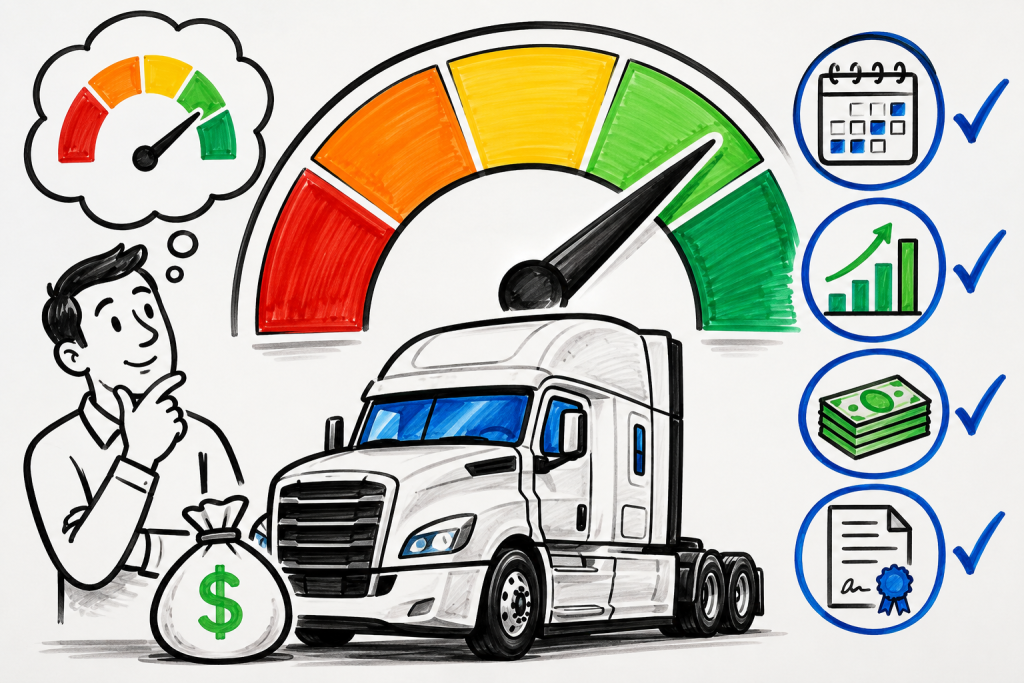
If you are asking what credit score for truck financing, the honest answer is that there is no single cutoff. A 750 score can make a deal easier, but plenty of truck finance approvals happen below that. In commercial lending, the score matters, but it is only one part of the file. The truck itself, your time in business, your cash flow, your down payment, and the way the transaction is structured can all affect the outcome.
That matters because truck financing is not the same as financing a personal vehicle. Lenders are looking at a business-use asset that is supposed to generate revenue. A semi-truck, box truck, dump truck, tow truck, or sprinter van is not just transportation. It is equipment tied to work, contracts, routes, and operating income. That gives a strong deal more room than a simple consumer credit decision.
In the commercial truck market, many lenders start to get more comfortable once a borrower is in the mid-600s or higher. Stronger credit can open more options, better terms, and lower upfront cash requirements. But that does not mean borrowers under that range are automatically out.
A borrower with a score above 700 will usually have more flexibility, especially if the business is established and the equipment makes sense for the operation. Scores in the 650 to 700 range often remain financeable, particularly when there is solid time in business, verifiable income, or a reasonable down payment. Below that, approvals may still be possible, but the structure may change. The lender may want more money down, a newer unit, stronger bank activity, or additional support in the file.
So if you want a practical benchmark, many truck financing opportunities become easier around 650 and stronger around 700-plus. Still, credit score alone does not decide the file.
Commercial truck financing is built around risk, collateral, and repayment ability. A credit score helps lenders measure payment history and overall credit management, but it does not tell the whole story of a trucking business or owner-operator.
For example, a borrower with a 630 score and two years in business, active contracts, and strong bank statements may present a better lending profile than someone with a 700 score but limited commercial history and inconsistent deposits. The type of truck also matters. A late-model sleeper with reasonable mileage may fit a lender’s guidelines more easily than an older unit with high miles and limited resale value.
This is where deal structure matters. The same borrower can look very different to lenders depending on how the file is packaged, what documentation is provided, and whether the requested terms match the risk profile.
Credit is one factor, but most commercial truck lenders also review time in business, industry experience, monthly revenue, bank statements, existing debt, equipment age and condition, and the amount being financed. Some will also look closely at whether the truck is being purchased from a dealer, auction, or private party.
For startups and first-time owner-operators, lenders may put more weight on personal credit because there is less business history to review. For established companies, the operating history and cash flow can carry more influence.
Borrowers with excellent credit, usually in the 720-plus range, often have the widest financing options. They may qualify for more competitive structures, longer terms, or lower down payment requirements depending on the truck, the business, and lender guidelines.
Borrowers in the good credit range, often around 660 to 719, are still in a solid position for many truck financing programs. This range can work well for owner-operators, fleet expansion, and replacement units, especially when the file shows stable business performance.
Fair credit, often around 600 to 659, can still be workable in commercial truck finance, but more of the file needs to make sense. Lenders may want stronger recent payment history, proof of operating income, or more cash into the deal. The truck itself may also need to fit tighter age, mileage, or value standards.
Below 600, financing gets more selective. That does not always mean impossible, but it usually means fewer lender options and more emphasis on compensating factors. Recent credit issues, tax liens, repossessions, or major delinquencies can create additional challenges even when the score itself is not far off.
A down payment can make a meaningful difference. It reduces lender exposure and shows borrower commitment. If your credit is borderline, putting money down may help offset risk and improve the structure.
Time in business also matters. A company that has been operating for two or three years with stable deposits generally presents less risk than a brand-new entity. That said, startups are active in the truck market every day. For newer businesses, lenders may focus more on the owner’s background, CDL status if relevant, prior industry experience, and the expected revenue from the unit.
Equipment quality is another big factor. A clean, marketable truck with reasonable age and mileage gives lenders more confidence than an older truck with high miles, deferred maintenance, or limited resale support. Buying from an established dealer can also help in some transactions because documentation tends to be cleaner and the collateral easier to verify.
Cash flow may matter more than borrowers expect. Lenders want to see that the business can support the payment while handling fuel, maintenance, payroll, insurance, and working capital needs. Strong bank statements can help tell that story.
If your score is lower than you want it to be, the best move is not always to wait six months and hope for a better number. Sometimes the smarter path is to structure the request correctly now.
That may mean choosing a truck with a lower purchase price, increasing the down payment, or documenting your income more clearly. It may also mean avoiding an older unit that creates added collateral risk. In some cases, replacing a weak file with a better one is less about changing your score and more about changing the deal.
You should also be realistic about what lenders will notice. Recent late payments, maxed-out revolving debt, charge-offs, and unpaid collections can affect the file differently than an older isolated issue. A 640 score with improving credit behavior may be viewed differently than a 640 with fresh delinquencies.
Most truck financing requests move more smoothly when the borrower is prepared. Lenders may ask for an application, equipment quote or invoice, business bank statements, proof of time in business, and sometimes tax returns or financials depending on the file. Startups may also need to provide more background on operating experience.
Clean documentation saves time. It can also help a financing partner present the deal to the right lenders based on the asset type, borrower profile, and transaction details.
For startup trucking companies, the question of what credit score for truck financing comes up even more often because there is less business history to support the request. In many startup files, personal credit takes on a bigger role.
A startup borrower with strong personal credit, industry experience, and cash to put down may have solid options. A startup with weaker credit may still have a path, but the lender may want more support in other areas. That could include a stronger down payment, a more conservative equipment choice, or clearer proof of how the truck will be used to generate revenue.
This is where specialized commercial financing support matters. Truck deals are not all the same. A first-time owner-operator buying one used semi is different from an established contractor adding a dump truck, or a towing company replacing a rollback. Matching the deal to the right program can matter just as much as the score itself.
A lot of borrowers spend too much time trying to find one magic number. Commercial truck financing does not work that way. The better question is whether your overall file supports the request.
If your credit is strong, that helps. If it is average, deal structure becomes more important. If it is challenged, the right equipment, documentation, cash flow, and lender fit can still make a difference. That is especially true when the truck is central to business operations and revenue production.
For businesses financing semi-trucks, box trucks, tow trucks, dump trucks, sprinter vans, and other commercial units, the goal is not just approval. It is getting into the right structure for your operation, your cash flow, and your growth plans. If you are looking at truck financing now, focus less on chasing a perfect score and more on presenting a financeable deal that makes business sense.
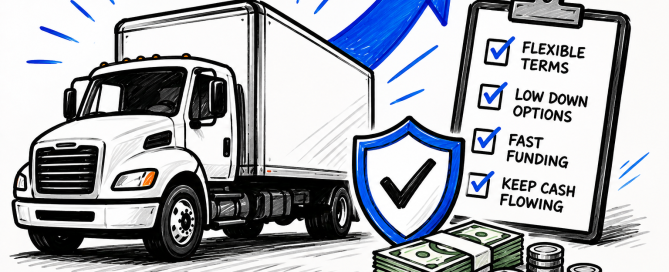
Find the best commercial vehicle financing for trucks, vans, and fleets. Learn what affects terms, approvals, down payments, and timing.
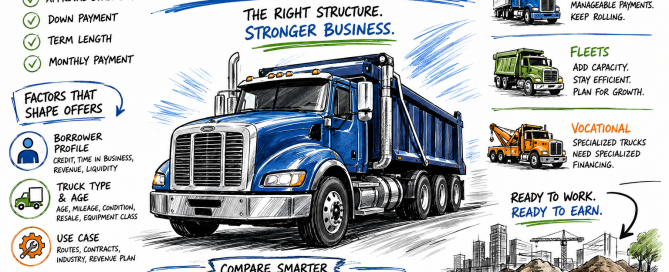
Learn how to find the best heavy duty truck financing deals with better terms, lower cash outlay, and structures that fit your fleet goals.

Best semi truck financing for new owner operators starts with the right structure, paperwork, and lender fit to protect cash flow and get rolling.
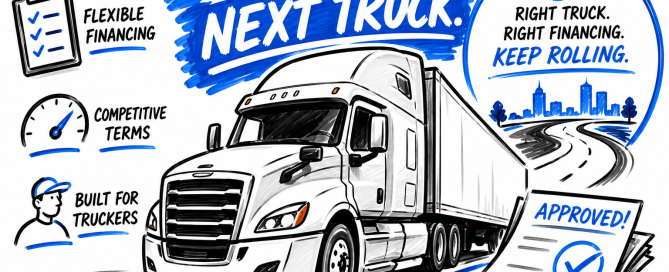
Looking for the best semi truck financing companies? Learn what sets top providers apart, which terms matter, and how to choose the right fit.
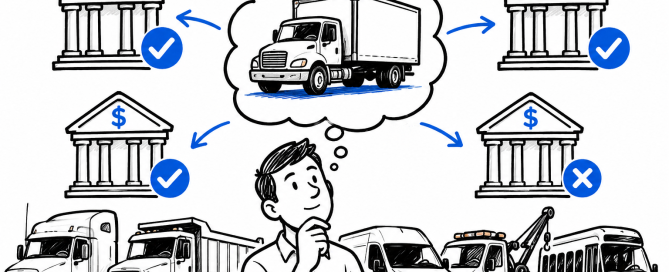
What banks finance commercial vehicles? Learn which lenders typically fund work trucks, vans, and fleets, and what affects approval and terms.