Advantages of Financing a Dump Trailer for Your Business
Advantages of Financing a Dump Trailer for Your Business [...]

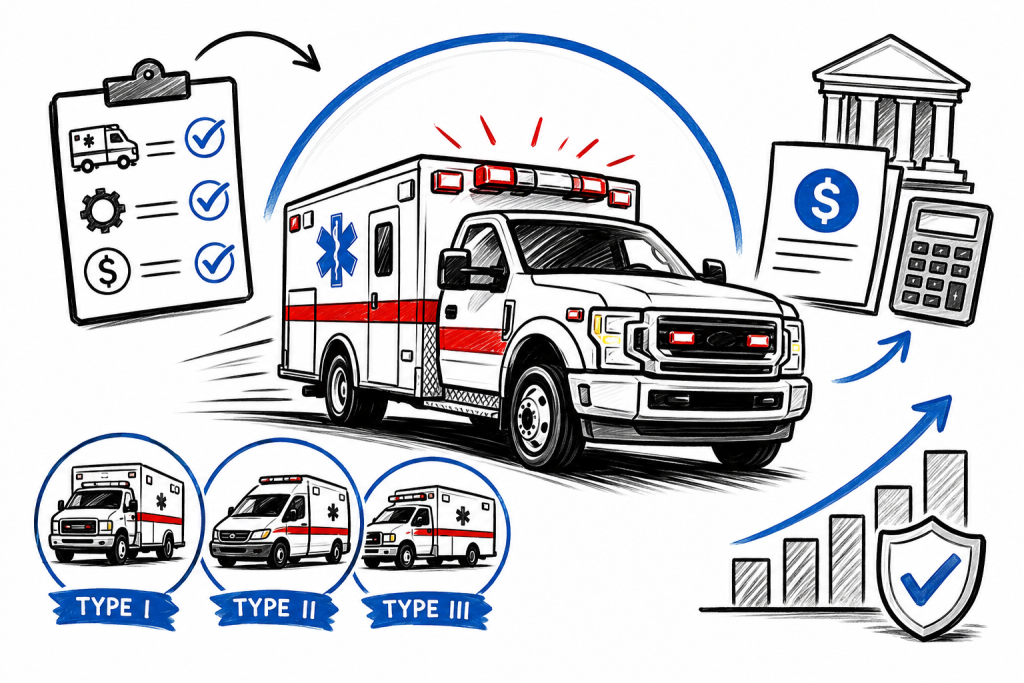
An ambulance that is out of service is more than a parked vehicle. It can reduce coverage capacity, delay scheduled transports, force overtime, and put revenue contracts under pressure. Knowing how to finance ambulances starts with matching the transaction to the vehicle’s expected service life, your operating model, and the cash flow the unit will produce once it is placed in service.
For established EMS providers, hospitals, fire departments, private medical transport companies, and specialty fleet operators, ambulance financing is an equipment decision as much as a credit decision. The best structure is not always the one with the lowest monthly payment. It is the one that gets the right unit into service while preserving enough working capital for staffing, insurance, maintenance, supplies, and dispatch operations.
Lenders and finance sources evaluate ambulances differently than ordinary passenger vehicles because the asset is specialized, costly, and tied to a defined commercial use. Before seeking terms, be clear about exactly what is being purchased.
A Type I ambulance uses a truck-style cab and chassis with a separate patient compartment. A Type III uses a cutaway van chassis, while a Type II is generally van-based. Each configuration has different acquisition costs, resale considerations, and expected duty cycles. A new, professionally built Type I or Type III unit from an established manufacturer may be easier to place than a highly customized unit with limited resale demand.
The quote should separate the chassis, patient module, permanent equipment, and any add-ons when possible. Items such as power-load systems, stretchers, radios, emergency lighting, HVAC upgrades, bariatric equipment, and communications hardware can materially change the financed amount. Clear vendor documentation helps a financing partner present the asset accurately to appropriate funding sources.
A remounted ambulance deserves its own analysis. Remounting a viable patient module onto a new chassis can reduce the capital cost compared with buying a fully new unit. It can also extend the useful life of equipment your team already knows. The tradeoff is that the age, condition, manufacturer, warranty, and marketability of the module may affect available structures and advance rates.
The first question should be how the ambulance earns revenue. A 911-response unit, an interfacility transport vehicle, a wheelchair or stretcher transport unit, and a hospital-based fleet vehicle can have very different utilization patterns. Financing should reflect that reality.
A term loan or equipment finance agreement is often a practical fit when the business expects to own the ambulance at the end of the term. The vehicle serves as collateral, and payments are typically fixed for the agreed period. This can work well for fleets buying long-life assets and planning to retain them through much of their useful service cycle.
A lease structure may make sense when preserving cash is the priority or when the organization expects to refresh vehicles on a planned cycle. Depending on the transaction and finance source, a lease may offer different end-of-term options than a traditional ownership structure. The lower-payment option is not automatically the better option, however. Review the end-of-term obligation, expected mileage, maintenance plan, and whether the vehicle will remain useful after the initial term.
Some established operators use a larger down payment to reduce the financed balance and monthly obligation. Others prefer to preserve capital for payroll, fleet maintenance, or a second unit coming later in the year. Possible low-down-payment or zero-down structures may be available for qualified borrowers, but they depend on credit strength, time in business, fleet history, asset details, documentation, and lender requirements.
Payment timing also matters. A monthly payment is common, but certain businesses with predictable contract billing may want to discuss an alternative payment schedule. It depends on the finance source and the borrower’s documented revenue pattern. The goal is not to force a payment structure around an assumption. It is to align the obligation with how cash actually moves through the operation.
An established business with documented operating history is generally in a stronger position than a newly formed company, particularly when the ambulance will be used in a regulated or high-liability environment. Finance sources commonly look at the business and the equipment together.
Key considerations include time in business, business and guarantor credit profile, current debt obligations, fleet size, payment history, and available liquidity. They may also review the company’s revenue trend, transportation or medical-service contracts, insurance coverage, licensing, and the intended use of the vehicle. A provider adding two units to support a newly awarded hospital transport contract presents a different credit story than one replacing an aging vehicle without clear utilization data.
The ambulance itself matters as well. New units from recognized manufacturers and established dealers are often more straightforward than older units, private-party purchases, or highly modified assets. For used ambulances, expect questions about model year, mileage, chassis condition, service records, module age, title status, and whether the unit meets your state and local operating requirements. High mileage is not always disqualifying, but it can affect term length, down payment expectations, and which funding sources will consider the request.
Avoid treating the purchase order as the only required document. Up-to-date financial statements, recent business bank statements, tax returns when requested, debt schedules, proof of insurance, and a detailed equipment quote can reduce avoidable delays. The exact documentation depends on the transaction size, business profile, and funding source.
A new ambulance typically offers the longest expected service window, current safety features, full manufacturer warranties, and a cleaner financing profile. It also carries the highest purchase price and may involve a build schedule. If a vehicle is needed to replace a failed unit immediately, a dealer’s available inventory may be more practical than ordering a custom build.
A used ambulance can be a sensible way to add capacity at a lower acquisition cost. The critical question is not simply whether the price is attractive. It is whether the remaining service life justifies both the purchase price and the financing term. A lower-cost unit that needs major chassis work, module repairs, or equipment replacement shortly after delivery can be more expensive than a newer option.
Remounts sit between these choices. They can preserve a quality module and put it on a new chassis, but the transaction requires careful documentation. The finance source may need to understand who is performing the remount, what warranties apply, how the finished unit will be titled, and the value of the completed asset. A specialized equipment finance partner can help coordinate those details with the vendor and funding source before delivery becomes a problem.
The financed amount is only one part of the capital decision. Before finalizing the structure, build a realistic deployment budget that includes insurance, registration, licensing, medical equipment, graphics, radios, fuel, maintenance reserves, and training or onboarding costs. An ambulance can be delivered before every operational expense is fully accounted for.
Also consider the replacement cycle. If your organization traditionally runs ambulances for seven years but the chassis is approaching its mileage threshold in year five, a longer term may create a period where the payment remains while uptime becomes less predictable. Conversely, financing over too short a period can consume capital that would be better used to support operations and growth.
For larger fleet purchases, decide whether it is better to finance units separately as they are delivered or structure a planned acquisition program. Separate transactions can match actual delivery dates. A broader plan may simplify budgeting and create consistency across replacement cycles. The right approach depends on vendor lead times, contract commitments, cash flow, and how quickly each unit can be put into service.
Ambulance transactions can involve multiple vendors, custom specifications, state requirements, chassis availability, and delivery timing. A general-purpose financing process may not recognize why a remount invoice differs from a standard vehicle invoice or why a completed unit needs specific equipment documentation.
Commercial Fleet Financing works as a specialized commercial equipment finance broker and financing partner, helping qualified businesses evaluate structures and access multiple funding sources. That can be useful when the deal involves a new build, a used unit with strong maintenance history, a remount, or a multi-unit fleet purchase. Available terms, down payment requirements, and funding timing remain dependent on the borrower, asset, documentation, vendor, deal structure, and lender requirements.
Bring a detailed quote, your intended deployment plan, and a clear picture of the business’s existing fleet to the conversation. A well-prepared ambulance financing request gives decision-makers something more useful than a purchase price: it shows how the vehicle will support reliable service and produce revenue once the keys are in hand.

Advantages of Financing a Dump Trailer for Your Business [...]

How to Choose the Right Dump Trailer Finance Plan [...]

Should You Lease or Finance a Dump Trailer? Adding [...]

How Fleet Owners Can Upgrade to Newer Models With a [...]

How Dump Trailer Financing Helps Contractors and Hauling Businesses [...]