Top Fleet Acquisition Strategies for Growing Businesses
Compare top fleet acquisition strategies for replacing, expanding, and financing commercial vehicles while protecting cash flow and uptime with confidence.

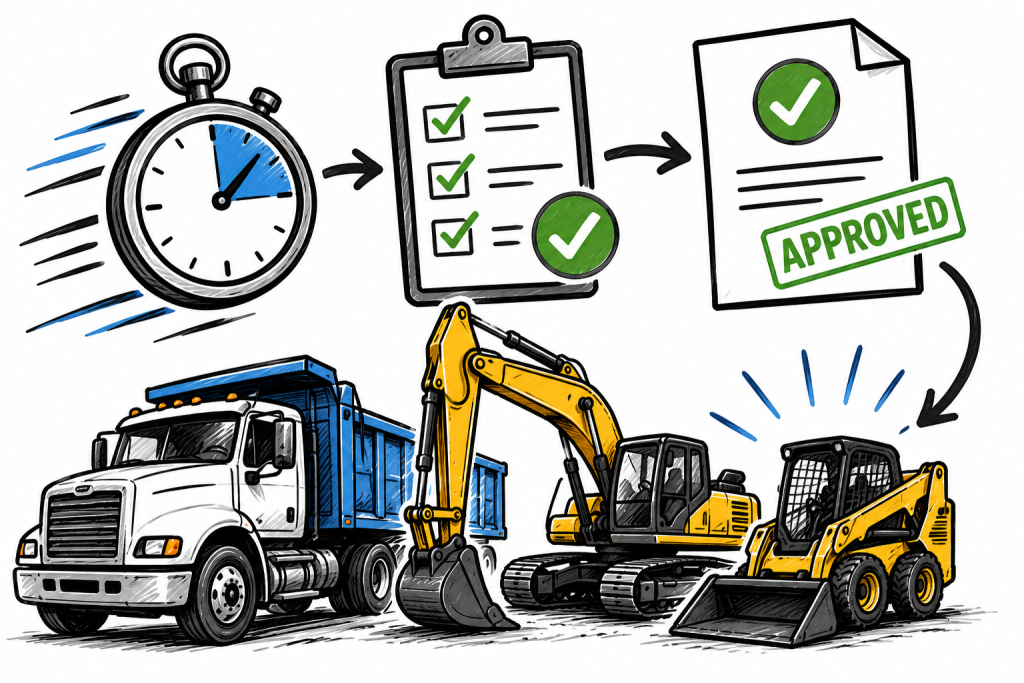
A replacement truck sitting at a dealer is not producing revenue. Neither is an excavator needed for a signed job, a wrecker needed to cover a new territory, or a forklift that would remove a production bottleneck. That is why business owners ask, how fast is equipment funding? The practical answer is that a well-prepared transaction can move quickly, but the timeline depends far more on the borrower, asset, seller, and documentation than on the application alone.
For established businesses, equipment financing may move from initial review to approval and funding in a matter of days. Some straightforward, well-documented transactions may be eligible for a decision quickly and, in limited cases, funding in as little as 24 hours. That outcome is conditional on a strong credit profile, sufficient time in business, appropriate equipment, a cooperative vendor, complete documents, and the selected funding source’s requirements.
It helps to separate the transaction into three stages: credit review, approval, and funding. A quick credit decision does not automatically mean the equipment can be paid for that same day. Funding occurs after the lender’s conditions are met and the transaction documents, equipment details, insurance requirements, and vendor information are in order.
For a late-model semi-truck purchased from an established dealer by a company with a proven operating history, the process can be relatively efficient. The buyer may submit a completed application, recent bank statements or financials when requested, equipment quote, and basic business information. If the file fits a lender’s program, an approval may follow promptly. The remaining work is usually confirming the truck’s VIN, mileage, title status, invoice, insurance, and final closing documents.
A more complex transaction can take longer. Consider a used 12-year-old excavator from a private seller, a specialized rollback with extensive upfitting, or several trailers being acquired from different sellers. These deals may require more equipment review, valuation support, title verification, photos, inspections, or added borrower documentation. Speed is still possible, but it should not come at the expense of resolving issues that could delay delivery or create problems after purchase.
The strongest predictor of speed is whether the transaction is easy to understand and document. Lenders evaluate both repayment capacity and collateral quality. A business that has operated profitably for several years, maintains good credit, has an established fleet or equipment base, and can document cash flow will generally present a clearer file than a company with limited operating history or incomplete records.
Time in business, commercial credit, payment history, annual revenue, cash flow, and existing debt all affect the review. A company replacing three aging tractors in an established fleet may be evaluated differently than one making its first major equipment purchase. Existing fleet history can also help explain why the purchase is necessary and how the asset will generate revenue.
A strong file does not eliminate underwriting. It can reduce follow-up questions and make it easier to match the request with an appropriate financing program. If the request is large relative to revenue, includes several assets, or involves a seasonal business, the financing source may reasonably request financial statements, interim statements, debt schedules, or additional bank information.
New and late-model equipment from reputable dealers is often simpler to finance than older, specialized, or unusual collateral. For trucks, mileage, engine type, maintenance condition, and vocational application matter. For construction equipment, lenders may look at model year, hours, configuration, marketability, and whether attachments are included in the quote.
A $90,000 late-model dump truck used in an established paving operation may fit a different financing profile than an older unit with unusually high mileage or a custom-built vehicle with a narrow resale market. Neither situation is automatically unfinanceable. They simply may call for a different structure, more down payment, a shorter term, or additional review.
The vendor can materially affect the timeline. A dealer that routinely handles commercial transactions usually knows how to provide an itemized buyer’s order, VIN or serial number, wiring instructions, title information, and insurance details. Private-party transactions often require extra verification, particularly when titles, liens, payoff information, or equipment condition must be confirmed.
The cleanest file includes a complete quote or invoice showing the buyer, seller, purchase price, taxes and fees where applicable, equipment description, VIN or serial number, and any included accessories. A mismatch between the application, invoice, and insurance certificate can create avoidable delays.
The requested term, advance amount, payment frequency, trade equity, and down payment can change both the underwriting path and the funding schedule. Some qualified businesses may have low- or zero-down options available, while other transactions require cash down because of asset age, credit considerations, concentration risk, or lender guidelines.
Preserving working capital is a valid reason to finance, but the fastest structure is not always the best structure. A lower upfront outlay may support cash flow for payroll, fuel, materials, or maintenance. A larger down payment, however, can strengthen the file or improve the range of available programs. The right choice depends on the business’s operating needs, not just the closing date.
Most delays are preventable. The common issue is not that financing is inherently slow. It is that a key detail arrives late, changes after approval, or does not match the rest of the file.
A truck buyer may switch to a different unit after receiving approval, only to find that the replacement has higher mileage or a different model year. A contractor may add attachments that were not included on the original quote. A vendor may provide wire instructions that need independent verification. Insurance coverage may be obtained late or may not list the correct lienholder or loss payee language. Each issue is manageable, but each can extend the timeline.
Businesses should also expect additional review when equipment is being purchased across state lines, delivered to a remote site, titled in a different entity name, or acquired from a private seller. These are ordinary commercial transactions, but they require careful coordination.
The best way to improve timing is to prepare before selecting the equipment. Start with a realistic budget that includes the asset, taxes, delivery, upfitting, attachments, and any required repairs. Know whether the equipment is replacing an existing asset, adding capacity, or supporting a new contract. That operating context helps explain the purchase and supports a sound financing request.
Have current business details available, including legal entity information, ownership, time in business, and the equipment quote. Be prepared to provide financial documents if the request warrants them. If you are buying a vehicle, confirm the VIN, mileage, title status, and intended use early. For a used asset, ask the seller for photos, maintenance records when available, and any information needed to establish condition and value.
It is also wise to involve a financing partner before putting down a nonrefundable deposit or committing to a delivery date. Commercial Fleet Financing, Inc. works as a specialized equipment finance broker and financing partner, helping qualified businesses match their transaction with suitable funding sources while coordinating documentation and vendor requirements. That early coordination can reduce rework when the equipment, borrower profile, and financing structure need to align.
A fast close has value when equipment downtime is costing money or a revenue opportunity has a narrow window. But the objective is not merely to fund quickly. It is to put the right asset into service with a payment structure the business can support and documentation that allows the seller to deliver without surprises.
Before moving forward, discuss the equipment type, age, seller, purchase price, business history, and required in-service date with an experienced commercial financing professional. A clear conversation at the start often does more to protect the timeline than any last-minute rush.
Compare top fleet acquisition strategies for replacing, expanding, and financing commercial vehicles while protecting cash flow and uptime with confidence.
Does equipment age matter? Learn how age, mileage, condition, seller type, and useful life can affect commercial equipment financing options and timing.
Use this fleet acquisition checklist to assess equipment fit, costs, financing readiness, vendors, and uptime before committing capital to a purchase.
A fleet financing partner review helps established businesses compare lender access, equipment knowledge, terms, timing, and support before they commit.

Learn how to finance ambulances with terms that protect cash flow, fit vehicle specifications, and help qualified medical fleets stay ready for service.